

Three Viral Controversies Changed My Mind About Black Social Media
After three viral controversies, I’m asking a harder question about Black social media: when did disagreement become an invitation for Black humiliation?
When did disagreement become an invitation for Black humiliation?
I have a master's degree in digital media.
I've spent years studying how people communicate online—how algorithms reward outrage, how engagement shapes conversation, and how social media influences culture.
Ironically, I never expected my own career to become a case study.
Over the last six years, I've found myself at the center of three separate viral controversies.
In 2020, I led the campaign calling out Philadelphia's PlayPenn Theatre over racism, exclusion, and leadership. What started as artists demanding accountability became a national conversation covered by WHYY, American Theatre, PhillyVoice, and other publications.
A few years later, my play Harriet Tubman: Love Slave sparked another national debate. Public figures, including columnist Charles M. Blow and writer Michael Arceneaux, criticized the work, helping fuel conversations that reached CNN, HuffPost, and thousands of people online.
And now, for a third time, I've found myself in the middle of another viral conversation.
After questioning transparency surrounding an official social media account connected to Philadelphia Mayor Cherelle Parker's administration, I was blocked by Press Secretary Leah Uko. I shared my experience online, and the conversation quickly spread. While looking into it further, I also came across Reddit posts from other users describing similar concerns about comment moderation. Those posts don't prove anything on their own, but they suggested I wasn't the only person asking questions.
Three completely different stories.
Three completely different issues.
Yet every single time, I've watched the conversation follow the same script.
The issue changes.
The comments don't.
Instead of debating the argument...
People debate my masculinity.
My sexuality.
My appearance.
My mother.
Apparently wearing a bonnet disqualifies me from asking questions.
Apparently asking difficult questions makes me "anti-Black."
Apparently questioning institutions means questioning my manhood.
As someone who studies digital media, that's the part I can't stop thinking about.
Not because it happened to me.
Because it keeps happening.
We've become incredibly good at humiliating one another online.
Especially in Black digital spaces.
We've mastered the clapback.
The drag.
The quote tweet.
The viral "read."
Our humor is brilliant.
Our creativity is unmatched.
But somewhere along the way, I wonder if we started rewarding humiliation more than dialogue.
The funniest insult often gets more engagement than the strongest argument.
The algorithm rewards performance over persuasion.
And when identity becomes easier to attack than ideas, identity becomes the target.
Disagree with me.
Tell me I'm wrong.
Challenge my work.
Challenge my politics.
Challenge my questions.
That's healthy.
That's necessary.
But answer the argument.
Not the bonnet.
Not my masculinity.
Not my mother.
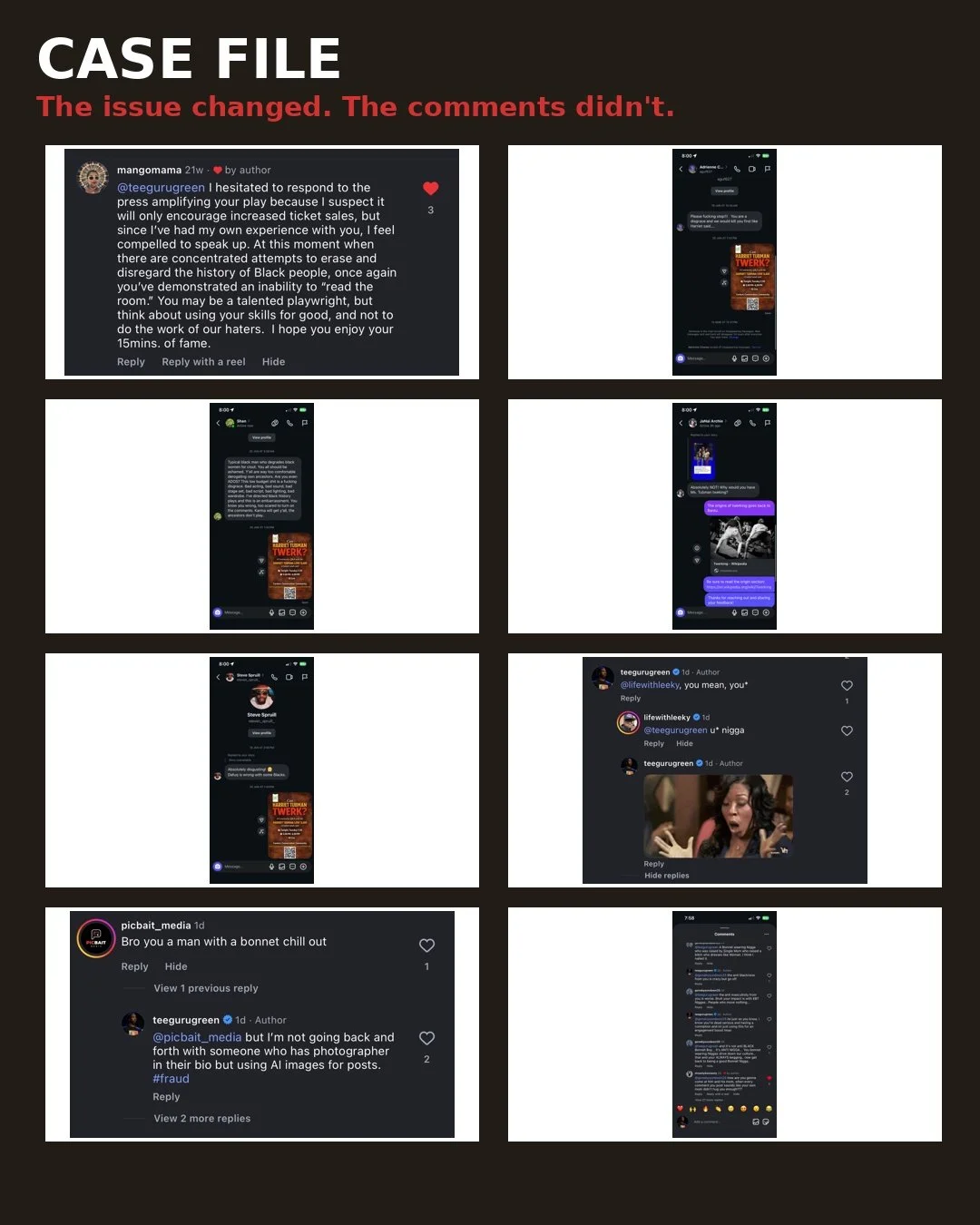
The screenshots attached to this article aren't here to earn sympathy.
They're here as evidence of a pattern I've now witnessed across three separate controversies spanning six years.
Different issues.
Different audiences.
The same playbook.
I don't claim to have all the answers.
In fact, I'm asking a question.
Why are we becoming so comfortable with Black humiliation online?
Because if public humiliation has become our default response to disagreement, then we're not just changing how we argue.
We're changing who we become.
Suggested "Further Reading"
PlayPenn (2020)
WHYY — Theater artists speak out against PlayPenn leadership
PhillyVoice — Does Philly Theater Have a Race Problem? (2017)
Philly Inquirer — PlayPenn is addressing racism and sexual misconduct after its summer implosion